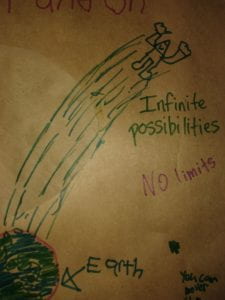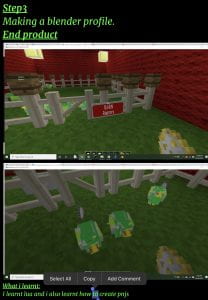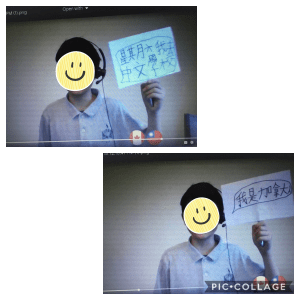
Student blogfolios was the main goal for my class this past year. I felt that the quality of writing and learning in each subject would improve through the use of blogfolios. Just a couple of weeks before the school year ended, students finally launched individual blogfolios. The students got a chance a customize their blogfolios and learn how to post their work. I am so happy that I had the opportunity to be part of the excitement myself. I also found it to be the perfect way to end my year with these students and to learn alongside them.
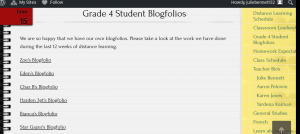
It was around this time last year that I attended the Building Learning Communities Conference in Boston with four of my colleagues. I came home inspired by all that I had learned at the conference, and I started a blog. As Silvia Tolisano explained to us in her workshop, if I wanted my students to reflect and think metacognitively about their learning, I needed to do the same. I started the blog and pretended it was my secret online journal. I wrote about how I would start my year. I also wrote about my hopes and wishes for teaching this group of children. It was also the place where I could document my learning and professional growth.
Two years ago, my PGP( professional growth plan) was to improve the academic skills and engagement in learning by having the students become guest bloggers on the class blog. My colleague Faye and I had similar PGPs, and we both started our work by teaching our students in grades three and four, respectively, all about blogging during the 2018-2019 school year.
Each class started by making a paper or google docs blog post and sharing it with their classmates. The students gained skills such as researching, putting thoughts into their own words, the importance of copyright, and using copyright free pictures. They also learned to read and make appropriate comments on their classmates’ blog posts, all while becoming good digital citizens.
The students also became guest bloggers of the week on our classroom blogs. I thought they would take ownership of their learning through this venue, but to be honest, they didn’t. My grade four classes did take part in the Edublogs Student Blogging Challenge. They loved getting comments from other students and teachers in other parts of the world. It made a difference when they realized other people were reading their work. They also loved visiting other blogs, making comments, and interacting with other students. I had hoped they would become motivated and engaged in writing their weekly guest posts. The students didn’t get as excited as I would have liked.
My original goal was to start blogfolios at the beginning of the year. We then hoped to launch in March before our school year changed course. Luckily we did launch before the end of the year, and what I observed and learned in such a short time has inspired me to make blogfolios an integral part of my teaching regardless of the grade I happen to teach.
The students’ writing did improve through the use of blogfolios. They paid attention to spelling, punctuation, and the quality of their writing. At the beginning of distance learning, we wrote persuasive essays. For many children, the assignment proved to be challenging. It took a lot of effort and encouragement to get them to write an essay. A few children wondered why they should write an essay when no one would read them. Writing speeches for public speaking proved to be difficult as well.
I then let the students write a blog post of their choice, and I told them it would go in their blogfolios. The students had the freedom to choose their topics. Something amazing happened; the students started writing and writing any chance they got. The writing flowed, the blog posts were interesting. Competitive skiing, Minecraft, and Electricity were a few of the topics. The amount of writing doubled and tripled, the quality improved as well. I got to know my students in a whole new way and to see what they what made them passionate. The thought of other people besides their teacher reading their work excited them too. The students presented their blogposts to the class and answered questions. Everyone was engaged and interested in what their classmates had written. These students needed to end of the year and remain excited about their learning.
We had a whole group discussion reflecting on our writing from persuasive essays, speeches, to blog posts. I told the students that I had noticed how excited and motivated they were when they asked to work on their blog posts, we talked about how much more they were writing as well. The students reflected how they found it so much easier to write about subjects that interested them. You don’t have to do as much research you can write about what you know. They talked about how they wanted to share what they were interested in with others. Writing for their blogfolios seemed effortless and came so naturally to them.
The students received their first comments, and they were thrilled that someone read their work. They were happy to reply. They also started to write in French and Hebrew too. I am pleased that they will get a chance to continue putting their work into their blogfolios and documenting their learning throughout the years. My hope is the students take even greater ownership of learning in a few years. I am excited to see where this platform can take them.
As for myself, I will be back teaching Grade 3 classes again. I will positively be setting up blogfolios for my students, having them do blogposts, learn all the skills, and take part in the student blogging challenge. I look forward to helping my students document their learning, think metacognitively, and share their voices with an authentic audience. I believe that the students will learn so much and be able to push the boundaries of the traditional grade three curriculum. Stay tuned! The 2020-2021 school year should be an exciting one.